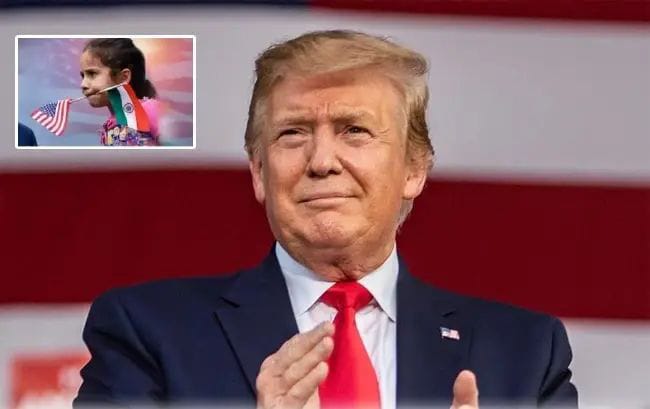
NOB-USA news: New President Donald Trump has repealed the law that grants natural USA citizenship to immigrants if they have children born on American soil. A single executive order has put a full stop to the policy that has been in place for almost a century. “Our federal government does not recognize birthright citizenship for children born in the United States to illegal immigrants,” Trump clarified. However, what impact will this decision by Trump have on non-resident Indians? Is it possible to amend the law?
What is birthright citizenship?
According to US laws not only those born to citizens of that country but everyone born in America gets citizenship there. The United States has been granting birthright citizenship to refugee children through the 14th Amendment to the Constitution of 1868, with the intention that all those born on American soil are citizens of this country. This process has continued uninterrupted until now. However, this has been put on hold with the recent executive order issued by Trump. According to Trump’s order, children born to parents who are not American citizens at the time of the child’s birth, or whose father is legally in the United States, will not be granted American citizenship. Also, even if the father is a permanent resident, the same rule applies even if the mother is residing in the United States on a temporary visa.
Will there be an impact on non-resident Indians?
The number of non-resident Indians living in the United States is increasing rapidly. By the end of 2024, 5.4 million NRIs will be living there. Indians constitute about 1.47 percent of the total population of the United States. Of these, 34 percent were born in the United States. The rest are immigrants. In this context, there is no doubt that Trump’s decision will have an impact on Indians. Children born to those who go to America on a temporary visa and are waiting for a green card will not be granted US citizenship.
How will this be affected?
* Children born to Indian parents in America will not be granted citizenship by birth.
* Many Indian immigrants, who are already struggling to get green cards, will find that if their children do not also get citizenship there, the green card issuance process will be further delayed.
* If those born in America do not get citizenship by birth, they will not be able to apply to the government to bring their parents to America after they turn 21. This will mean that the parents will have to stay in India and the children in America. Legal problems may arise.
* ‘Birth tourism’ will disappear. Many high status Indian women, with the intention of getting American citizenship for their children, go to America at the time of delivery. This is called ‘birth tourism’. This will be stopped from now on.
* It is almost impossible for children born to Indian students who went to the US on a non-immigrant visa to get US citizenship. Most of the foreign students living in the US are Indians. Especially in the engineering and technology fields. Some of them marry people from other countries there. Such people will have to face many problems in terms of their children.
* According to a factual document released by the US Immigration Council in 2011, if birthright citizenship is stopped, it will affect almost everyone. Even Americans will have to prove that their children are from this country.
Not that easy
Even if President Trump signs the executive order, there are likely to be legal complications to repeal this policy. Changing the provisions of the US Constitution is a very long process and is fraught with challenges. To amend the US Constitution, a two-thirds majority vote is required in the House and Senate. After that, three quarters of the state legislatures must approve it. In the new Senate, Democrats have 47 seats and Republicans have 53. On the other hand, in the House, Democrats have 215 seats and Republicans have 220. In this context, this constitutional amendment may not be easy.
