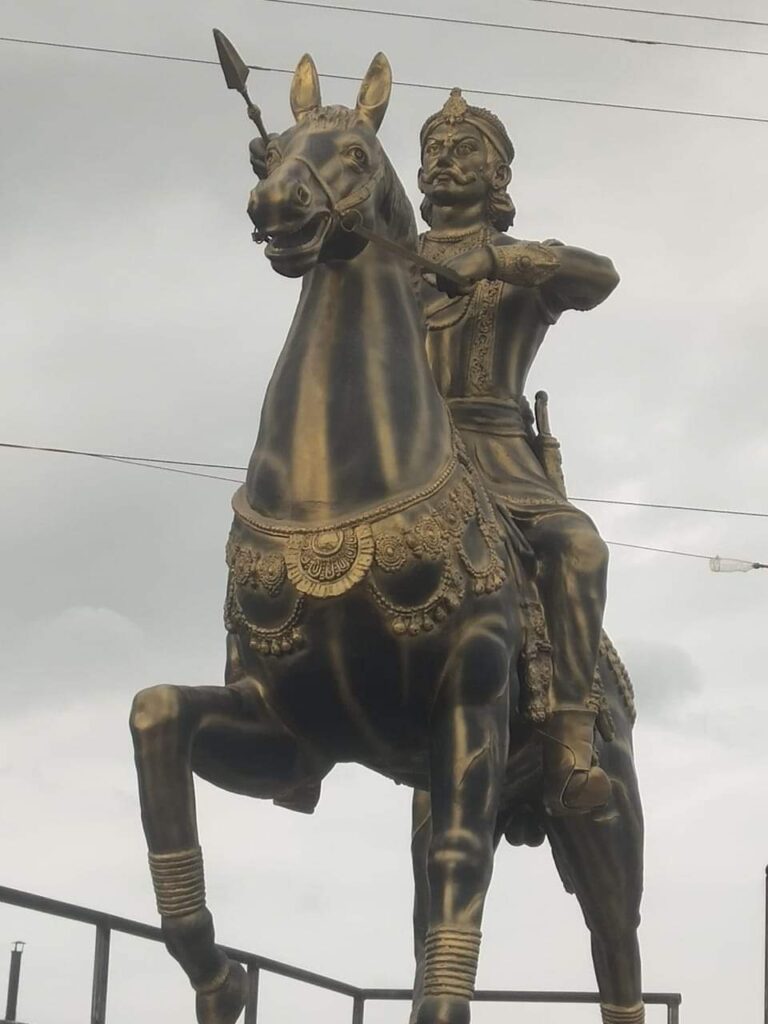
NOB- Telangana news: Sardar Sarvai Papanna Goud, a common man who proved that if the oppressed and the Bahujans fight together, they can achieve state power, a great social Bahujan revolutionary, a Bahujan fighter who has worked for a society without caste, religion and caste differences in almost 350 years, Sardar Sarvai Papanna Goud. The first Bahujan king Sardar Sarvai Papanna Gaud was the great hero who took responsibility for the welfare of the above Bahujans and established the first Bahujan kingdom. Mahatma Jyoti was a great social revolutionary who implemented social justice before Raopule.
Against the dominance of the upper castes under the shadow of the monarchy, he was a hero who could not tolerate the anarchy of the zamindars and jagirdars. Sardar Sarvai Papanna Gaud, the Bahujan Emperor who raised the flag on Golconda Fort against the Mughal rule with Khilashapur as his center.
Papanna was born in Khilashapur in Raghunathapalli mandal of Janagama district
(1650-1709). The son of Nasagoni Darmanna and Sarvamma. His father died when he was young and his mother Sarvamma brought him up. People affectionately called him Papanna Goud, Papanna Dora. Sarvamma was called Papadu. Papanna was a great devotee of Ellamma, the deity of the Gauda caste. He also worshiped Lord Shiva. As per his mother’s wish, Gowda adopted the profession.
According to the Dhulimitta Sasanam, on August 18, 1650, Papanna Goud was born in the Goud caste in Warangal district. An inscription of Dhulmitta Veeragallu, an important figure in Gauda history, says, Bandipota Gowda Shahpur Khila Puli Gowda Yebadi Roddi Shabbarayuda, Poudaru Papanna Gowd.
During his childhood, he tended cattle and observed the social, economic and political conditions of the day and discussed with his friends. The seeds of anti-dominant Brahmin ideology were formed in Papanna from his childhood. He gradually opposed the traditions of regular worship by the time he reached adulthood. He made a vow with his mother that he would free the people from slavery.
Papanna mostly used to go around with people of other castes. Chakali Sarvanna, Mangali Masanna, Kummari Govindu, Jakkula Perumallu, Dudekula Piru, Kotwal were the main followers of Saheb Papanna. All of them were Bahujans.
He decided to put an end to the rule of the Mughal kings in Telangana, observe the atrocities committed by the Tebedars, Zamindars, Jagirs, nobles and landlords and to free the slaves and raise the Bahujan flag on the Golconda fort.
Papanna had no hereditary leadership, no money, no power. He formed a guerilla army with 12000 people, infantry forces with 3000 people, and a security camp with 500 people. He joined the Dalits and tribals and taught them martial arts. He attacked the Mughal army with his army and made his hometown Khilashapur the capital and established his kingdom in Sarvai Peta in 1675.
Papanna was a contemporary of Chhatrapati Shivaji. As Shivaji fought to end Muslim rule in Maharashtra, Papanna also fought to end Mughal rule in Telangana. From 1687 – 1724 he fought against the army of Mughal Emperor Aurangzeb. Papanna occupied each area and built Vijaya durgas and forts (21). Till 1678 he took Tatikonda and Vemulakonda under his control.
Historians say that the forts were built to find enemies in plain sight. There are historical signs that modern weapons were also used. The fort has bastions on four sides, another high bastion in the middle, a space wide enough to walk from one bastion to another bastion, and there are holes on the fort wall suitable for pitta walls to face the enemies. Also there are three tunnels to go out of this fort. He built the forts so that the enemies did not get caught.
It was Sarvai Papa who first stopped the expansion of Mogalai in Telangana. His empire extended from Tatikonda, Kolanupaka, Cheryala to Husnabad and Huzurabad in Karimnagar district. Papanna married a Muslim woman. She was the sister of the Fauzdar (Military Governor) of Bhuvanagiri Fort.
A common man’s conquest of impregnable forts is a testament to his strategy. Starting with Sarvaipet fort, he brought about 21 forts under his control.
Landlords who were enraged by sinful ideas, Nizams who were Moghal stooges and conspiracies weakened the army. Between 1700 – 1705 he built another Durga at Khilashapuram. Climbing one step at a time, he finally captured Golconda fort and ruled for 7 months. Mughal king Bahudar Shah recognized Papanna’s prowess and proclaimed him the Lord of Golkonda.
Papanna comes from a simple Gowda family so he knows all the hardships of the people. That is why there are no taxes in the kingdom of sin. The zamindar used to attack the subedars with his guerilla army for the sake of treasury. He distributed the money stolen from them to the people. He also distributed their lands to the people. Papanna did many popular deeds. He was a social justice in his kingdom. He built Chek Dam in Tati Konda. As he was a great devotee of Ellamma, he built the Ellamma temple in Huzurabad. Although it has changed form, it is still the same today.
Unable to accept that a simple Gita worker was the Lord of Golconda, the dominant classes of Agrakars spread false propaganda against Bahudur Shahku Papanna of Delhi. Historians say that Bahadur Shah of Delhi, who believed in those things, attacked Papanna’s army and fought for six months. One night during the war (1710), Papanna was caught by a traitor. Historians Richards and Hanumantha Rao said that Papanna was hanged after a few days, his body was cut into pieces and his head was sent to Delhi. They described the sinful attempt as a double coup. Papanna worked for the expansion of the Bahujan Kingdom (from Orugallu to Golconda) for 20 years against the anarchy of the Mughal lords and the communal policies.
The conquests by the upper castes, looting and looting were depicted as the greatest struggles in the history of the past. Sarvai Papanna, who resisted domination and defied slavery, has been portrayed as a robber by upper caste historians. Sardar Sarvai Papanna Goud, the first Bahujan king who constantly supported the welfare of the Bahujans, distorted the history.
Picchuka Kuntla, Dasari Candra, and Veeramushti used to retell the history of Papanna as heroic songs. Basic evidences related to the history of Papanna were found through folk art forms.
The history of Papanna was written in 1874 in the Indian Antiquary magazine by the English poet J.Y.Boyle. A statue is enshrined in the London Museum as a mark of Papanna’s heroism. Cambridge University Press Book wrote about Papanna. After researching the history, late Acharya Pervaram Jagannatham, former VC of Telugu University, proved that Papanna was from Khilashapuram in Telangana region. Famous poets Mallampally Somasekarsharma, Adiraju Veerabhadra Rao, Cholleti Nrisimhasharma Ramarajulu brought to light the history of Papana. Papanna Goud’s biography is written by Kompalli Venkatesh Goud. BSL Hanmantha Rao praised the heroism and people’s government in his history of the Andhras.
The upper caste dominant historians of that time and the Andhra rulers of that time distorted the history of Papanna and trampled it without the world knowing. After the independence of the state, Chief Minister KCR decided to officially organize the birth anniversary of Sardar Sarvai Papanna, Chakali Ailamma, Komuram Bhim Konda Laxman Bapuji, the fighters from Telangana.
The Telangana government has issued an order on October 30, 2022 to officially celebrate Sarvai Papanna Jayanti on August 18 and Vardhanthi on April 2.
The Telangana State Government has allocated Rs 1.26 crore for the preservation and restoration of the heritage of the historical fort built by Sardar Sarvai Papanna Goud in the 17th century in Khilasapur of Jangama district.
Centuries ago, he told the people of Papanna to fight against the tyrannical rule and Brahminism (humanism). Caste, religion, class, race and other divisive aspects of the society should be left aside and the masses should move together for the establishment of an equal society. Bahujans should participate in the state power. Research on the history of Papanna is still to be done. Governments have the responsibility to protect the archeological monuments found. Papanna idols should be erected and the history of Papanna’s hero should be made known to the people. The future generations should be inspired. The social responsibility to participate in jobs and government power according to the population proportion is on all the masses as the heirs of sin.
An article by Pakala Shankar Goud
An Educationalist
9848377734
