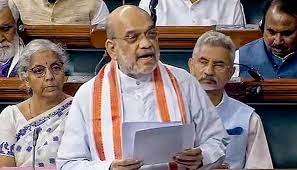
NOB- New Delhi news: One of the five oaths taken by the Prime Minister Narendra Modi before the country on August 15th was to end all signs of slavery,the three bills introduced on 11.08.2023 are going to fulfil this one vow of Modi.
On 11.08.2023 Modi government brought 3 new Bills by repealing Indian Penal Code, 1860, Criminal Procedure Code, (1898), 1973 and Indian Evidence Act, 1872, which were enacted by the British and passed by the British Parliament.
Indian Penal Code, 1860 will be replaced by Bharatiya Nyaya Sanhita Bill, 2023, the Criminal Procedure Code, 1898 will be replaced by the Bhartiya Nagarik Suraksha Sanhita Bill, 2023 and the Indian Evidence Act, 1872 will be replaced by the Bharatiya Sakshya Bill, 2023.
These three outgoing laws were made to strengthen and protect the British rule and their purpose was to punish, not to give justice.
The soul of the three new laws will be to protect all the rights given to Indian citizens by the constitution, and, their purpose will not be to punish but give justice.
These three laws made with Indian thought process will bring a huge change in India’s criminal justice system.
Modi government has brought this law by taking a very principled decision to bring citizens at the centre, instead of governance.
Prime Minister Narendra Modi had said in 2019, all the laws made during the time of the British across all the departments, should be made in accordance with present time and in the interest of the Indian society after adequate discussion and consideration.
18 States, 6 Union Territories, the Supreme Court, 16 High Courts, 5 Judicial Academies, 22 Law Universities, 142 Members of Parliament, around 270 MLAs and public have given their suggestions on these new laws.
The Home Minister said, for 4 years intense discussions were held on these laws and he himself was present in 158 consultation meetings.
Bhartiya Nagarik Suraksha Sanhita Bill, which will replace CrPC, now has 533 sections, 160 sections of old law have been changed, 9 new sections have been added and 9 sections have been repealed.
Bharatiya Nyaya Sanhita Bill 2023, which will replace the Indian Penal Code, will have 356 sections instead of the earlier 511 sections, 175 sections have been changed, 8 new sections have been added and 22 sections have been repealed.
Bharatiya Sakshya Bill, which will replace the Evidence Act, will now have 170 sections instead of the earlier 167, 23 sections have been changed, 1 new section has been added and 5 have been repealed.
These three old laws had signs of slavery, they were passed by the British Parliament, on 11.08.2023 Modi government have come up with new laws by removing these signs of slavery from a total of 475 places.
The law expands the definition of documents to include electronic or digital records, e-mails, server logs, computers, smart phones, laptops, SMS, websites, locational evidence, mails, messages on devices.
Provision has been made in this law to digitize the entire process from FIR to case diary, case diary to charge sheet and charge sheet to judgement.
Videography has been made compulsory at the time of search and seizure which will be part of the case and will not implicate innocent citizens, without such recording by the police no charge sheet will be valid.
Prime Minister Narendra Modi took a historic decision to set up the National Forensic Science University to promote forensic science in a bid to increase the conviction ratio.
After three years, every year 33,000 forensic science experts and scientists will be available in the country, the target has been set in the law to take the conviction ratio above 90%.
The visit of the forensic team is being made compulsory on the crime scene of crimes having provision for punishment of 7 years or more, through this, the police will have a scientific evidence, after which the chances of acquittal of the culprits in the court will be very less.
Modi government is going to start e- FIR for the first time after 75 years of the Independence for the convenience of the citizens, with this initiative, the citizens will be able to lodge complaint even outside of their police station area.
Provision of e-FIR is being added for the first time, every district and police station will designate a police officer who will officially inform the family of the arrested person about his arrest online and in person.
The statement of the victim has been made compulsory in the cases of sexual violence and the video recording of the statement has also been made compulsory in the cases of sexual harassment.
It will be compulsory for the Police to give the status of the complaint in 90 days and thereafter every 15 days, to the complainant.
No government will be able to withdraw a case of imprisonment of 7 years or more without listening to the victim, this will protect the rights of the citizens.
Scope of summary trial has been increased in petty cases, now crimes punishable up to 3 years will be included in summary trial, with this provision alone, over 40% of cases in sessions courts will end.
A time limit of 90 days is fixed for filing the charge sheet and depending on the situation, the court can further give permission for 90 more days, the investigation will have to be completed within 180 days and trial should begin.
Courts will now be bound to give notice of framing of charge to the accused person within 60 days, within 30 days after the completion of arguments, the Hon’ble Judge will have to give verdict, this will not keep the decision pending for years and the order will have to be made available online, within 7 days.
Government has to decide on permission within 120 days for trial against civil servant or police officer else it will be treated as deemed permission and trial will be started.
A provision has been brought for attachment of property of declared offenders, a new provision of harsh punishment against inter-state gangs and organized crimes is also being added to this law.
Sex on the pretext of false promise of marriage, employment, promotion and false identity has been made a crime for the first time, 20 years of imprisonment or life imprisonment in all cases of gang rape.
Provision of death penalty has also been made in case of crime with girls below 18 years of age, for mob lynching also, all three provisions of 7 years in jail, life imprisonment and capital punishment have been made.
Earlier, there was no provision for snatching of mobile phone or chain from women, but now a provision has been made for the same.
Provision has been made for imprisonment for 10 years or life imprisonment in case of permanent disability or being brain dead.
Punishment increased from 7 to 10 years for a person committing crime with children, provision has been made to increase the amount of fine in many crimes.
There were many cases of using pardon for political gains, now the death penalty can only be changed to life imprisonment, life imprisonment to a minimum of 7 years and 7 years to a minimum of 3 years, no culprit will be freed.
Modi government is going to repeal sedition law completely because India is a democracy and everyone has the right to speak.
Earlier, there was no definition of terrorism, now crimes like armed insurgency, subversive activities, separatism, challenging the unity, sovereignty and integrity of India have been defined in this law for the first time.
A historic decision regarding trial in absentia has been taken, a person declared fugitive by a Sessions Court judge will be tried and sentenced in his absence, no matter where in the world he may be hiding, if the fugitive has to appeal against punishment, he will have to follow Indian law.
A total of 313 changes have been made in this law which will bring a widespread change in India’s criminal justice system, now anyone will be able to get justice within a maximum of 3 years.
In this law, special care has been taken of women and children, it has been ensured that criminals are punished and the police cannot misuse their powers.
On one hand, laws like sedition have been repealed, on the other hand, provision of punishment for heinous crimes like exploiting women by cheating and mob lynching have been made, provisions also made for crack down on organized crimes and terrorism.
